1

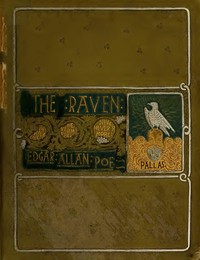
The Works of Edgar Allan Poe, The Raven Edition Table Of Contents And Index Of The Five Volumes — A Reader’s Guide
(0 User reviews)
599
Project Gutenberg
2008
Not confirmed
Short stories; Fantasy fiction; Horror tales, American; American fiction -- 19th century; Poe, Edgar Allan, 1809-1849; Indexes
Readers of public-domain and historical texts
Project Gutenberg digital edition
en
Edition facts
Words
458,110
Reading time
1992 min
Text sections
161
The Works of Edgar Allan Poe, The Raven Edition Table Of Contents And Index Of The Five Volumes — A Reader’s Guide can be approached with a clearer sense of reading commitment from its source measurements: 458,110 words, 33 hr 12 min estimated reading time, and 161 detected text sections.
The text analysis averages about 23.2 words per sentence, while the detected sections provide another way to judge how the source is divided.
Project Gutenberg metadata also associates the work with “Short stories,” connecting these edition facts with the source record’s subject description.
Source:
Project Gutenberg record #25525
This editorial note examines Poe's authorial choices in diction, dialogue, and description across the five-volume Raven Edition, drawing on excerpts from 'The Gold-Bug,' 'The Murders in the Rue Morgue,' 'The Fall of the House of Usher,' and 'The Narrative of Arthur Gordon Pym' to highlight his precise, psychological prose.
Read the complete public-domain text at its original source.
Read on Project GutenbergIn the excerpt from The Narrative of Arthur Gordon Pym, Poe builds tension through a meticulous accumulation of physical and emotional details. The protagonist's hands "absolutely refusing their office" and knees "knocking violently against each other" convey terror not through abstraction but through bodily failure. The description of drawing lots—"every particle of that energy which had so long buoyed me up departed like feathers before the wind"—uses simile to render psychological collapse as a physical process. This passage exemplifies Poe's method: he anchors extreme mental states in concrete, sensory language, forcing the reader to inhabit the character's deteriorating consciousness.
Diction of Dread: Precision in the Macabre
Poe's diction in the Pym excerpt is notable for its clinical specificity. Words like "frailness of the tenure" and "appalling of purposes" pair abstract nouns with precise modifiers, creating a rhythm of intellectual horror. He avoids vague terms; instead, he specifies "the most appalling of deaths—a death for the most appalling of purposes," doubling the adjective to intensify the threat. This lexical precision recurs in The Tell-Tale Heart, where the narrator's "acute" senses are described with anatomical exactness. Poe's vocabulary often draws from legal, scientific, or philosophical registers—"tenure," "speculation," "imbecile conduct"—which lends an air of rational analysis to irrational situations. The effect is a chilling contrast between the orderly language and the chaotic events it describes.
Dialogue as Psychological Pressure
In the lot-drawing scene, dialogue is sparse but charged. Parker's voice "urged me to relieve them at once from the terrible anxiety they were enduring"—the phrase "terrible anxiety" is the only direct speech reported, and it functions as a goad. Poe uses dialogue not for exposition but to heighten internal conflict. The protagonist's silent reasoning—"I thought of falling on my knees... of suddenly rushing upon them"—is rendered as interior monologue, a stream of panicked calculations. This technique appears in The Black Cat and The Imp of the Perverse, where characters articulate their own compulsions. By limiting spoken exchange, Poe focuses attention on the mind's self-justifications and moral unraveling, making the reader complicit in the character's logic.
Description of Setting and the Body
Poe's settings are often minimal yet oppressive. In the Pym excerpt, the forecastle becomes a stage for a life-or-death ritual; the physical space is reduced to a hand holding splinters. More elaborate descriptions appear in The Fall of the House of Usher, where the house's "eye-like windows" and the tarn's "black and lurid tarn" mirror the characters' decay. Poe frequently describes bodies in states of extreme duress: the protagonist's "heart almost bursting from my bosom," his "convulsive shudder and closed eyes." These physical markers externalize psychological states, a hallmark of his style. The body becomes a text upon which terror is written—trembling knees, gasping breath, senseless falls—creating a visceral reading experience that bypasses intellectual distance.
Structure of Suspense and Delay
Poe manipulates narrative time to maximize suspense. In the lot-drawing, the process is stretched over several paragraphs: the protagonist delays, considers alternatives, then forces himself to act. Each step is described with agonizing detail—"It was fully five minutes before he could summon resolution to draw." This elongation of crucial moments is a structural device Poe uses repeatedly, as in The Pit and the Pendulum and The Cask of Amontillado. The reader is held in a state of anticipation, aware of the outcome but forced to endure the character's uncertainty. Poe also employs retrospective narration, as in Pym, where the first-person voice recounts events with the clarity of hindsight, yet the prose retains the immediacy of present terror. This dual perspective—knowing and reliving—deepens the psychological complexity.
Readers approaching this five-volume edition will find Poe's authorial choices consistent across genres: from detective fiction to horror to satire, his diction remains precise, his dialogue psychologically driven, and his descriptions physically immediate. The excerpts here offer a lens into his craft, but the full collection reveals the range of his stylistic experiments. Pay attention to how Poe varies sentence length—from clipped, urgent phrases to elaborate, periodic constructions—and how he uses repetition for rhythmic effect. These are the tools of a writer who understood that language itself could be a source of dread.
Years among Poe's Raven Edition taught me how a single word can lower a room's temperature. That precision of feeling—the quiet dread, the careful pause—I find echoed unexpectedly in Short Stories of the New America Interpreting the America of this age to high school boys and girls — Edition Insights. Both volumes trust the weight of an unspoken thought. A kinship across centuries, really.
There are no reviews for this eBook.
There are no comments for this eBook.
Reader reflection
How will you remember this book?
Save your reaction, strongest insight, and memorable passage.
Your progress
0
/
10
2
What was your overall reaction to the book?
3
Would you recommend this book to another reader?
4
What was the reading difficulty like?
5
Did the book give you something worth debating?
6
How distinctive were its ideas or approach?
7
What did you think about the pace?
8
How clear did the writing feel?
9
What is the main idea you are taking away?
10