1

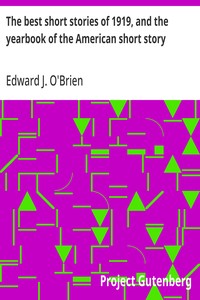
The best short stories of 1917, and the yearbook of the American short story — Reading Companion
(0 User reviews)
858
Project Gutenberg
2007
Not confirmed
Short stories, American; American fiction -- 20th century; Short stories -- 20th century -- Bibliography; Short stories -- 20th century -- Indexes
Readers of public-domain and historical texts
Project Gutenberg digital edition
en
Edition facts
Words
197,413
Reading time
859 min
Text sections
23
This digital edition of The best short stories of 1917, and the yearbook of the American short story — Reading Companion is described by source-level measurements including 197,413 words, 14 hr 19 min estimated reading time, and 23 detected text sections.
The text analysis averages about 12.9 words per sentence, while the detected sections provide another way to judge how the source is divided.
Project Gutenberg metadata also associates the work with “Short stories, American,” connecting these edition facts with the source record’s subject description.
Source:
Project Gutenberg record #20872
Edward J. O'Brien's 1917 anthology collects twenty stories with a yearbook appendix, offering a curated view of early 20th-century American short fiction. The excerpts show varied voices—from a stoker's hurricane ordeal to a boxer's knockout—and O'Brien's editorial apparatus, including a roll of honor and magazine index, frames the selections.
Read the complete public-domain text at its original source.
Read on Project GutenbergEdward J. O'Brien's The Best Short Stories of 1917 opens not with a story but with a dense apparatus: a dedication to Wilbur Daniel Steele, a roll of honor listing magazines and their story counts, and a detailed copyright page naming each author and periodical. This editorial framing signals that the volume is as much a yearbook as an anthology, documenting the year's output in American short fiction. The first excerpt plunges into a hurricane at sea, following stoker Larry through a fire-room ordeal where 'every bolt and rivet sounded the overstrain forced upon it.' The prose is muscular and sensory, tracking the ship's progress from Barnegat Light to Jupiter.
The Editor's Yearbook Apparatus
O'Brien's volume includes a substantial yearbook section: a roll of honor of periodicals, a list of volumes of short stories published in 1917, and an index of stories indexed by magazine. The excerpts show the editor's method—he ranks magazines by the number of stories selected, with The Pictorial Review and The Century Magazine leading. This apparatus turns the anthology into a reference work, allowing a reader to trace the year's publishing patterns. The copyright page alone names twenty authors and their original venues, from The Saturday Evening Post to The Pagan Publishing Company, revealing the range of outlets for short fiction at the time.
A Stoker's Hurricane
The longest excerpt follows a freighter crew battling a hurricane. The narrative is tightly focused on the physical: 'Larry, squinting through a forecastle port, wondered how long its anchor chains would hold.' The prose shifts between technical precision—'one hundred and sixty, an' we've held between that and sixty-five'—and visceral description: 'a jarring shiver spread through the hull as the propeller, thrown high, raced wildly.' The scene builds tension through incremental detail: the speaking-tube whistles, the indicator clangs, the second watch cannot leave the forecastle. The story's voice is that of working men, with dialogue like 'It's up to us, men, to keep this ship afloat.'
A Knockout in the Forecastle
Earlier in the same story, a fight breaks out between Dan and a stoker. The action is swift: 'Dan's left broke down the guard; his right fist landed squarely on the stoker's jaw.' The scene is framed by the ship's routine—'Neville's watch went off duty'—and the fight is resolved with a command to 'douse your friend with a pail of water.' This incident, set before the hurricane, establishes the crew's dynamics and Dan's character. The juxtaposition of a casual brawl with the later life-or-death struggle suggests the story's arc from ordinary danger to extraordinary crisis.
The Volume's Structure and Scope
O'Brien's anthology is organized by story, not by theme, but the excerpts suggest recurring concerns: physical labor, maritime settings, and class dynamics. The yearbook appendix lists stories by magazine, not by author, emphasizing the periodical context. The volume includes a 'Roll of Honor' of magazines and a bibliography of story collections, making it a resource for studying the year's output. Readers should note that the excerpts represent only a fraction of the twenty stories; the full collection likely offers a wider range of voices, from Edna Ferber to Wilbur Daniel Steele, as indicated by the copyright page.
Approach this volume as both a reading collection and a historical document. The editorial materials—the roll of honor, the magazine index, the copyright list—provide a snapshot of the 1917 short story market. The stories themselves, as glimpsed in the excerpts, favor action and sensory detail over interiority. Readers interested in the craft of early 20th-century American fiction will find O'Brien's selections and apparatus equally revealing.
That rainy afternoon, I lost myself in O’Brien’s collection, especially the stoker’s grim fight against the sea. The roll of honor felt like a quiet map of forgotten voices. Later, idly tracing that map’s edges, I stumbled upon The mirrors of Tuzun Thune — Themes and Context, and something in its strange reflections matched the storm’s fading chill.
There are no reviews for this eBook.
There are no comments for this eBook.
Reader reflection
What was your reading experience?
Capture what you thought, learned, and would like to remember.
Your progress
0
/
10
2
How did the book work for you overall?
3
Would you encourage someone else to read it?
4
What was the reading difficulty like?
5
Could you apply anything you learned?
6
Was the book what you thought it would be?
7
Did you relate to its people, ideas, or situations?
8
How original did the book feel?
9
What changed or sharpened your thinking?
10