1

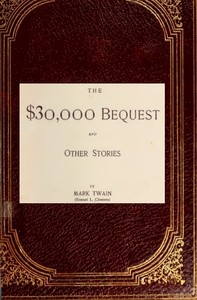
The $30,000 Bequest, and Other Stories — Story, Setting & Ideas
(0 User reviews)
561
Project Gutenberg
2004
Not confirmed
Humorous stories, American; United States -- Social life and customs -- Fiction; Short stories, American
Readers of public-domain and historical texts
Project Gutenberg digital edition
en
Edition facts
Words
99,039
Reading time
431 min
Text sections
13
The catalog record for The $30,000 Bequest, and Other Stories — Story, Setting & Ideas provides practical reading context through 99,039 words, 7 hr 11 min estimated reading time, and 13 detected text sections.
The text analysis averages about 20.4 words per sentence, while the detected sections provide another way to judge how the source is divided.
Project Gutenberg metadata also associates the work with “Humorous stories, American,” connecting these edition facts with the source record’s subject description.
Source:
Project Gutenberg record #142
Mark Twain's collection of short stories and sketches, including the title tale of a couple's fantasy spending of an expected bequest, showcases his characteristic humor, irony, and social observation. The excerpts reveal a focus on domestic details, psychological tension, and narrative voice.
Read the complete public-domain text at its original source.
Read on Project GutenbergThe title story, "The $30,000 Bequest," opens with a precise portrait of Lakeside, a town where "everybody knew everybody and his dog." Twain immediately establishes a contrast between the town's modest reality and the Fosters' private fantasies. Saladin Foster, a bookkeeper earning a steady eight hundred dollars a year, and his wife Electra, a "dreamer of dreams," are introduced through specific financial details: her initial purchase of an acre for twenty-five dollars, their systematic savings. This grounding in numbers and domestic economy sets the stage for the speculative extravagance that follows when they imagine inheriting a fortune.
Domestic Details and Psychological Depth
Twain builds his narratives through meticulous attention to household objects and routines. In "A Dog's Tale," the bedroom described includes "white counterpane, white pillows, carpeted floor, papered walls, pictures, dressing-table, with mirror and pin-cushion and dainty toilet things." The narrator's hesitation to use "towels too clean and white" conveys a sense of profanation, revealing character through material detail. The husband's pride in his wife's handiwork—"All her work; she did it all herself—every bit"—echoes the Fosters' domestic economy. These concrete descriptions anchor Twain's psychological insights, showing how characters' inner lives are expressed through their environments.
The Unseen and the Longed-For
Absence drives several stories. In "The Californian's Tale," the wife is away visiting family, and the husband's eager anticipation—"When you see her—ah, just wait till you see her"—creates a tension that the narrator finds both alluring and unsettling. The narrator resolves to leave "for my peace of mind's sake," only to be swayed by a second glimpse of her daguerreotype. This pattern of deferred presence recurs in "The $30,000 Bequest," where the Fosters' imagined wealth remains perpetually out of reach. Twain uses the gap between expectation and reality to generate irony and pathos, often leaving the reader to infer what is not shown.
Narrative Voice and Shifting Registers
The collection showcases Twain's range of narratorial tones. The opening of "The $30,000 Bequest" adopts a wry, reportorial style, cataloging salaries and savings with deadpan precision. In contrast, "A Dog's Tale" employs a sentimental, first-person animal perspective, while "The Californian's Tale" uses a more conventional first-person narrator who becomes emotionally entangled. Twain also includes essays and sketches, such as "How to Tell a Story" and "Advice to Little Girls," which shift to direct, instructional modes. This variety in voice—from the ironic to the earnest—demonstrates his versatility and his interest in the conventions of storytelling itself.
Readers approaching this collection will find a mix of fiction and non-fiction, with tones ranging from satirical to tender. The excerpts suggest that Twain is as interested in the psychology of anticipation and disappointment as in humor. Pay attention to how he uses specific objects—a daguerreotype, a savings account, a clean towel—to reveal character and advance narrative. The stories reward close reading of their structural and verbal details.
Reading the couple’s imagined fortune in The $30,000 Bequest, I remembered sitting with my grandmother, quietly dreaming aloud about what we’d never own. That same hushed, wistful feeling came back with A Young Man in a Hurry, and Other Short Stories — Inside the Classic—a different voice, yet the same ache of wanting something just out of reach, held gently inside the story.
There are no reviews for this eBook.
There are no comments for this eBook.
Reader reflection
Take a moment to reflect on this book
Create a short personal record of your experience with this book.
Your progress
0
/
10
2
Was reading this book enjoyable?
3
How likely are you to recommend this book?
4
What was the reading difficulty like?
5
Did the book meet your expectations?
6
How closely did the book connect with your experience?
7
How would you rate its originality?
8
Did you gain anything practical from the text?
9
In one sentence, what did you learn?
10