1

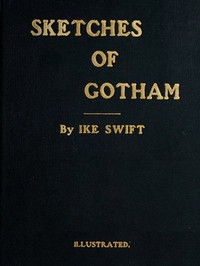
Sketches of Gotham — Edition Insights
(0 User reviews)
102
Project Gutenberg
2020
Not confirmed
New York (N.Y.) -- Fiction; Short stories, American; Young women -- Fiction; Single women -- Fiction; Man-woman relationships -- Fiction; Working class women -- Fiction; Women dancers -- Fiction; Nightlife -- Fiction
Readers of public-domain and historical texts
Project Gutenberg digital edition
en
Edition facts
Words
77,446
Reading time
337 min
Text sections
33
This digital edition of Sketches of Gotham — Edition Insights is described by source-level measurements including 77,446 words, 5 hr 37 min estimated reading time, and 33 detected text sections.
The text analysis averages about 22.1 words per sentence, while the detected sections provide another way to judge how the source is divided.
Project Gutenberg metadata also associates the work with “New York (N.Y.) -- Fiction,” connecting these edition facts with the source record’s subject description.
Source:
Project Gutenberg record #61454
Ike Swift's 1906 collection of 33 linked stories uses a recurring narrator and episodic structure to trace young women's lives in New York's nightlife and working-class venues, with precise attention to movement between scenes and the physical details of performance spaces.
Read the complete public-domain text at its original source.
Read on Project GutenbergIke Swift's Sketches of Gotham (1906) is structured as a sequence of 33 interconnected stories, each titled with a phrase that signals a transaction or transformation—"A Little Easy Money," "Casting an Old Shoe," "The Queen of Chinatown." The collection moves through New York's nightlife districts, from dance halls and theatres to hotel cafes and masked balls, with a recurring first-person narrator who observes and occasionally intervenes. The excerpts show a consistent attention to the physical arrangement of performance spaces: platforms, chairs "lined up like a regiment," palms on pedestals, and the gradual rise of lights during a dance. This editorial note examines how Swift uses structure, recurring images of consumption and display, and the movement between public and private scenes to shape the reader's experience.
Episodic Structure and the Narrator's Role
The book's 33 sections are not standalone sketches but linked by a narrator who appears as a witness, a confidant, or a participant. In the excerpt from "A Little Easy Money," the narrator recounts a manager's manipulation of a young dancer, using direct address ("you must know that this was the first season out for this girl") that creates a collusive tone. The narrator's voice is consistent across sections, offering commentary on the action without fully explaining motives. This structure allows Swift to shift between different characters and settings while maintaining a single perspective, giving the collection a novelistic unity despite its episodic form. The index of illustrations further emphasizes key moments—a dance, a knockout drop, a masked ball—that recur as turning points across multiple stories.
Recurring Images: Consumption and Display
Throughout the excerpts, consumption is linked to performance and moral compromise. In "A Little Easy Money," the manager plies the dancer with cocktails and champagne—"three pints of extra dry"—to "dull her sense of morality." The narrator describes the effect: "when the corks pop often enough it's hell let loose." This image of drinking as a prelude to exploitation recurs in other sketches, such as "A Case of Knockout Drops" and "The Queen of Chinatown." Display is equally central: the dancer's "superb figure" is a commodity, and her costume—"transparent gauze, with Turkish trousers and a bolero"—is described with clinical precision. The illustrations listed in the index reinforce this focus on physical appearance: "Her swell figure made her an attraction on the beach," "She had such a superb figure that she once posed for a sculptor."
Movement Between Scenes: Theatrical and Urban Spaces
Swift's narrative moves fluidly between different types of spaces, often within a single story. In the excerpt, the action shifts from the theatre to the hotel cafe to a private room with a platform, each space carrying its own social rules. The narrator notes the transition: "And now, a big room, carpeted, with palms on pedestals here and there, giving it an air of luxury, and a platform at one end." This attention to spatial detail—the "stage entrance," the "carriage to and from the hotel"—grounds the stories in a specific geography of New York's entertainment districts. The catalog subjects (nightlife, women dancers, working class women) reflect this focus on movement between public and private spheres, as characters cross from the stage to the street to the hotel room. The index titles further suggest journeys: "From the Woods to Broadway," "The Long Way 'Round."
Voice and Direct Address
The narrator's voice is distinctive for its colloquial directness and its use of second-person address. Phrases like "I tell you it's impossible" and "you must know" create a sense of intimacy, as if the narrator is confiding in the reader. This technique is consistent across the excerpts, suggesting that Swift uses the narrator to bridge the gap between the reader and the unfamiliar world of the stories. The narrator also employs a knowing, slightly cynical tone: "No good hardened old pelter would have halted at this hurdle." This voice is not omniscient—the narrator admits uncertainty about the dancer's thoughts ("she had a hazy idea that it was wrong")—but it guides the reader's interpretation. The effect is to make the collection feel like a series of oral tales, told by someone who has seen the underside of Gotham's nightlife.
Readers approaching Sketches of Gotham should attend to the way Swift builds meaning through repetition and variation across the 33 sections. The same images—drinks, dances, costumes, negotiations—reappear in different contexts, creating a cumulative portrait of a social milieu. The narrator's voice, with its direct address and colloquial rhythms, invites the reader into a world that is both specific and emblematic. Rather than seeking a single plot, consider how each sketch adds a new facet to the collection's exploration of performance, commerce, and survival in early twentieth-century New York.
Reading Ike Swift's careful tracking of those young women through smoky rooms, I found myself back in my grandmother's kitchen, her describing the Long Branch dance halls. Later, "Under the Redwoods — Edition Insights" resurfaced a similar hush, that same quiet attention to small, fleeting gestures in the Under the Redwoods — Edition Insights I once borrowed. It all feels like watching light shift on a wall, not a story told, but a moment remembered.
There are no reviews for this eBook.
There are no comments for this eBook.
Reader reflection
Your personal reading reflection
Build a private reading journal entry for this title.
Your progress
0
/
10
2
Did this book hold your interest?
3
How likely are you to recommend this book?
4
How easy was the book to follow?
5
How well did it match your expectations?
6
Which element worked best for you?
7
Did the book give you something worth debating?
8
Could you follow the author’s main argument?
9
What is the main idea you are taking away?
10