1

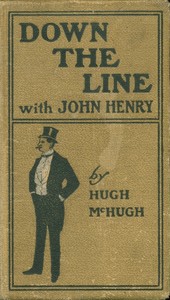
Down the line with John Henry — Context and Discussion
(0 User reviews)
263
Project Gutenberg
2022
Not confirmed
Short stories; Humorous stories; Young men -- Fiction; Upper class -- United States -- Fiction; Americanisms -- Fiction
Readers of public-domain and historical texts
Project Gutenberg digital edition
en
Edition facts
Words
12,573
Reading time
55 min
Text sections
2
Before opening Down the line with John Henry — Context and Discussion, the edition data offers a quick orientation: 12,573 words, 55 min estimated reading time, and 2 detected text sections.
The text analysis averages about 15.9 words per sentence, while the detected sections provide another way to judge how the source is divided.
Project Gutenberg metadata also associates the work with “Short stories,” connecting these edition facts with the source record’s subject description.
Source:
Project Gutenberg record #68504
In seven linked stories, John Henry narrates his comic misadventures in courtship, racing, golf, and hotel life, using a distinctive slang-laden voice. The tales contrast his bravado with his actual financial and social limits, offering a satirical portrait of upper-class American leisure at the turn of the century.
Read the complete public-domain text at its original source.
Read on Project GutenbergJohn Henry, the narrator of these seven linked stories, speaks in a voice that is immediately recognizable: breezy, boastful, and peppered with period slang. He calls himself a "Wise Boy" and a "real Rolando," yet his actions repeatedly undercut his claims. At the races, he bluffs about betting thousands while carrying only a five-dollar bill. His language—full of terms like "plunks," "dope," and "skates"—creates a comic tension between self-image and reality. The stories, originally published in 1901, follow John Henry through courtship, golf, automobile rides, and hotel stays, each episode revealing the gap between his swagger and his actual circumstances.
The Boastful Narrator and His Slang
John Henry’s narration is built on a foundation of exaggerated claims and specialized vocabulary. He describes himself as an expert on horse racing, telling Clara Jane he won $18,000 on a horse called "Benzine," then admits he lost $23,680 on a turtle named "Pink Toes." The numbers are absurdly large, and the inconsistency is part of the humor. His slang—"dub on the dope," "cut the guy-ropes," "go up in the air"—creates a distinct, period-specific voice. He uses terms like "plunks" for money, "skates" for untrustworthy people, and "benzine buggy" for an automobile. This language is not just decoration; it defines his character as a self-styled insider who is always slightly out of his depth.
Courtship as Competition
John Henry’s pursuit of Clara Jane is framed as a contest against rivals, particularly Clarence Edgerton Montrose, a college-educated man who "could talk fast and use long words." John Henry’s strategy is to outdo Clarence with spectacle: he rents a "horseless carriage" to impress Clara Jane, calling it "The True Lover's Departure in the Dream Wagon." He boasts that his "market price was $18,000 a square inch." Yet his schemes often backfire or reveal his insecurity. He admits that Clara Jane found Clarence "pleasant company" and that his own knowledge of automobiles was limited—"my education was complete" only after a few tries. The competition is less about romance than about status, and John Henry’s victories are temporary and precarious.
Rules, Lists, and Comic Structure
Several stories use lists and mock rules to structure the comedy. In "John Henry and the Hotel Clerk," he presents a set of hotel rules that parody real regulations: "Breakfast from 4 to 3; dinner from hand to mouth, and supper from what's left over." Rule 9 warns against disturbing the room clerk, and Rule 15 ends with "That will be about all from you." These lists create a rhythm of escalating absurdity. Similarly, the story titles themselves form a kind of list—"John Henry at the Races," "John Henry and the Drummers," etc.—suggesting a series of comic episodes. The structure emphasizes pattern and repetition, with each story offering a new setting for John Henry’s same blend of confidence and incompetence.
These stories reward attention to the specific texture of John Henry’s language and the recurring patterns of his self-presentation. Readers may notice how his boasts often contain their own refutation, and how the slang terms—many now obscure—anchor the humor in a particular time and place. The illustrations by McKee Barclay, mentioned in the list but not included here, likely added another layer of comic exaggeration. Approaching the text as a series of linked performances rather than a continuous narrative helps clarify its structure and intent.
I keep thinking about John Henry’s bluster in those hotel lobbies, how his voice fills every empty corner. It made me remember a quieter collection, In the Morning Glow: Short Stories — Edition Insights, where the silences between people seem to hold more truth than their words ever do. Both feel like sketches of a world just out of reach.
There are no reviews for this eBook.
There are no comments for this eBook.
Reader reflection
How did this book work for you?
Your answers remain private and are stored only in this browser.
Your progress
0
/
10
2
Did this book hold your interest?
3
Would you encourage someone else to read it?
4
How demanding did the text feel?
5
Did you gain anything practical from the text?
6
How closely did the book connect with your experience?
7
What did you think about the pace?
8
What was its emotional impact?
9
What is the main idea you are taking away?
10