1

The Arctic legions — Key Ideas to Explore
(0 User reviews)
507
Project Gutenberg
2025
Not confirmed
Short stories; Canada, Northern -- Fiction; Royal Canadian Mounted Police -- Fiction; Racially mixed people -- Fiction; Caribou -- Migration -- Fiction
Readers of public-domain and historical texts
Project Gutenberg digital edition
en
Edition facts
Words
5,166
Reading time
23 min
Text sections
1
This digital edition of The Arctic legions — Key Ideas to Explore is described by source-level measurements including 5,166 words, 23 min estimated reading time, and 1 detected text section.
The text analysis averages about 19.4 words per sentence, while the detected sections provide another way to judge how the source is divided.
Project Gutenberg metadata also associates the work with “Short stories,” connecting these edition facts with the source record’s subject description.
Source:
Project Gutenberg record #76834
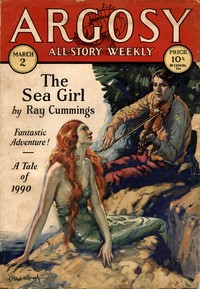
In this 1929 Argosy All-Story Weekly tale, Corporal Conroy of the Mounted and Yeyik, a Yellowknife half-breed, are trapped on a boulder amid a caribou migration. The excerpt focuses on a tense standoff over a revolver, with dialogue revealing a power struggle and cultural tensions, but the story's full plot and resolution remain unknown.
Read the complete public-domain text at its original source.
Read on Project GutenbergThe opening of The Arctic Legions drops the reader into a specific, high-stakes predicament: Corporal Conroy and Yeyik, a Yellowknife half-breed, are stranded on a boulder while a vast caribou herd migrates around them. The excerpt focuses almost entirely on a psychological duel over a revolver, with Yeyik using a babiche cord to toy with Conroy. The catalog subjects list “Racially mixed people — Fiction” and “Royal Canadian Mounted Police — Fiction,” but the text itself shows a more nuanced dynamic—Yeyik is not simply a villain but a taunting, clever antagonist who calls Conroy “sikak” and laughs at his own “joke.” The caribou migration, though a catalog subject, serves as a menacing backdrop rather than a central plot driver in the available text.
A Standoff Built on Small Details
The excerpt’s tension relies on precise physical and spatial details. Conroy’s attempt to reach the revolver is described incrementally: he “yawned, doubled his arms, threw his shoulders back, and at the same time reached out one long leg.” Each movement is measured, and the distance to the gun is repeatedly noted as “three inches.” Yeyik’s countermove—a moccasin tie-string attached to the trigger guard and held under his knee—is revealed only after Conroy’s repeated failures. The text does not explain how the cord was attached or when, leaving readers to infer Yeyik’s foresight. This cat-and-mouse game is the core of the excerpt, with dialogue that alternates between sneers and laughter. Conroy’s line “You are but a jest for the old squaws squatting in the teepees” and Yeyik’s retort “A strong hunter” show a clash of pride and identity, but the excerpt does not reveal who ultimately gains the upper hand.
Voice and Cultural Markers
The dialogue carries distinct markers of the period and setting. Yeyik’s speech includes the exclamation “Hai, hai, hai!” and the term “sikak,” which appears to be a derogatory epithet. Conroy’s responses are clipped and contemptuous, calling Yeyik’s trick “children’s games.” The narrative voice uses phrases like “the Mounted Policeman’s bronzed face” and “the half-breed killer,” aligning with early 20th-century adventure fiction conventions. However, the excerpt does not develop Yeyik’s interiority beyond his actions and taunts; he remains an opaque figure. The catalog subject “Racially mixed people — Fiction” is thus only superficially addressed—Yeyik’s mixed heritage is stated but not explored in the available text. Readers should note that the story may rely on stereotypes common to its era, and the excerpt alone does not provide a nuanced portrayal.
Setting as a Constraint, Not a Spectacle
The Barren Lands setting is established through sensory details: “the monotonous clicking of deer hoofs on the rock valleys” and “faint fingers of light touching the granite ridges.” The caribou migration is a constant auditory presence—“clatter of hoofs and the clicking of horns”—but it is not described visually in the excerpt. The boulder that “split the waves of migrating caribou” is the only physical feature mentioned. This minimalism focuses attention on the human conflict. The catalog subject “Caribou — Migration — Fiction” might suggest a nature-focused narrative, but the excerpt uses the migration as a pressure cooker for the standoff, not as a subject of ecological interest. The story’s title, “The Arctic Legions,” may refer to the caribou herd, but the excerpt does not confirm this. Readers should expect the environment to remain a backdrop rather than a central character.
Because the excerpt covers only the opening standoff, the story’s trajectory is unclear. Conroy and Yeyik may remain trapped, or the caribou migration may force a change in their dynamic. The text does not indicate whether the revolver is fired or the standoff resolved. Readers interested in early Mounted Police fiction or survival scenarios will find a concentrated dose of tension here, but the full narrative likely extends beyond this single scene. Approach the story as a period piece that prioritizes confrontation over character depth.
Reading that old Arctic standoff, the weight of that revolver between them, stayed with me for days. It reminded me of how a single moment can hold so much unspoken history. I kept thinking of Postscripts — Story, Setting & Ideas for that same feeling—how a story’s quiet spaces sometimes linger longer than its action ever could.
There are no reviews for this eBook.
There are no comments for this eBook.
Reader reflection
How did this book work for you?
Your answers remain private and are stored only in this browser.
Your progress
0
/
10
2
How much did you enjoy the reading experience?
3
Is this a title you would suggest to others?
4
What was the reading difficulty like?
5
How original did the book feel?
6
Would you like to discuss this book with someone?
7
Which part made the strongest impression?
8
Did the book deliver what you hoped for?
9
What changed or sharpened your thinking?
10