1

Stubborn people — Background and Themes
(0 User reviews)
140
Project Gutenberg
2025
Not confirmed
Short stories; Western stories; Oregon -- Fiction; Man-woman relationships -- Fiction
Readers of public-domain and historical texts
Project Gutenberg digital edition
en
Edition facts
Words
9,701
Reading time
43 min
Text sections
1
For Stubborn people — Background and Themes, the stored edition analysis reports 9,701 words, 43 min estimated reading time, and 1 detected text section.
The text analysis averages about 14.5 words per sentence, while the detected sections provide another way to judge how the source is divided.
Project Gutenberg metadata also associates the work with “Short stories,” connecting these edition facts with the source record’s subject description.
Source:
Project Gutenberg record #76938
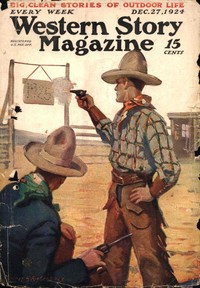
Ernest Haycox's 'Stubborn People' follows storekeeper Bud's scheme to reconcile homesteader Jim Hunter and a neighbor girl by firing a revolver through her window. The excerpts reveal a dry, colloquial voice and a focus on stubborn pride rather than conventional Western action.
Read the complete public-domain text at its original source.
Read on Project GutenbergErnest Haycox's 'Stubborn People' opens with storekeeper Bud on his porch, watching heat waves and reflecting that 'every act in a man’s life was affected by every other act.' The story's catalyst is a letter that makes Jim Hunter scowl 'bitter and unforgiving,' yet the excerpts never reveal its contents. Instead, the narrative dwells on Bud's plan to 'blast' stubborn pride by firing a revolver through a window—a scheme he admits 'was not the best idea in the world.' The catalog subjects list 'Man-woman relationships' and 'Western stories,' but the excerpts show a comedy of meddling rather than romance or range action.
Stubbornness as a Thematic Engine
The catalog subject 'Man-woman relationships' suggests a romantic plot, but the excerpts focus on Bud's assessment that both parties are 'too obstinate to listen to reason.' Hunter's reaction to the letter—crumpling it with a 'bitter and unforgiving scowl'—and Bud's later reflection that the two are 'like two fighters who struggled long after the original injury had been dead and buried' indicate that pride, not passion, drives the conflict. The word 'stubborn' appears in the title and in Bud's admiring thought that Hunter is 'stubborn as a mule.' The story's central action—a fake shooting meant to scare the woman into reconciliation—is a gambit born of frustration, not affection.
Voice and Setting in Burnt Creek
Haycox establishes a distinctive vernacular through Bud, who speaks in colloquialisms like 'sashay out' and 'a-foggin'.' The setting is a 'sand-floored clearing' surrounded by jack-pine forest, with 'shimmering heat waves' and a 'lazy drone' of insects. The Oregon landscape is not a backdrop for heroic action but a place of isolation where 'the abrasion of weather and work' hardens a man's nature. Bud's horse Toby, described as 'wise' but 'sentenced to a grievous disappointment,' adds dry humor. The catalog subject 'Oregon -- Fiction' is accurate, but the excerpts show a domestic, almost claustrophobic environment rather than open-range adventure.
The Unseen Letter and Incomplete Plot
The excerpts withhold key information: the letter's sender and contents, the woman's name, and the outcome of Bud's scheme. Hunter's reaction—'There never is'—suggests a pattern of disappointment, but the text does not confirm a romantic history. Bud's plan to 'put a bullet through that window' is described in detail, including his fear of being caught ('I'd sure be hamstrung') and his fall over a rock. The story is cataloged as 'Adventure & Picaresque Fiction,' yet the excerpts depict a bumbling, self-aware plotter rather than a heroic figure. Readers must infer the resolution from the setup, as the excerpts end before the shot is fired.
The excerpts from 'Stubborn People' offer a self-contained episode of rural scheming, but the missing letter and unresolved shot leave the central relationship undefined. Readers should attend to Haycox's use of indirect characterization—Bud's admiration for Hunter's stubbornness, the woman's unseen reactions—and the way the setting of Burnt Creek becomes a pressure cooker for pride. The story rewards attention to its laconic dialogue and the gap between what characters say and what they do.
There’s something almost tender in Haycox’s stubborn folk, the way pride digs in like a root. It reminded me of the quiet persistence in Story-Tell Lib — Key Ideas to Explore, where storytelling itself keeps a stubborn hold on what matters. Both feel like old friends who won’t budge, and I’m glad for that.
There are no reviews for this eBook.
There are no comments for this eBook.
Reader reflection
Your personal reading reflection
Build a private reading journal entry for this title.
Your progress
0
/
10
2
Was reading this book enjoyable?
3
Would you encourage someone else to read it?
4
How demanding did the text feel?
5
Did the book meet your expectations?
6
Was the book easy to understand?
7
Did the book give you something worth debating?
8
Could you see yourself revisiting this book?
9
What did this book teach you most?
10