1

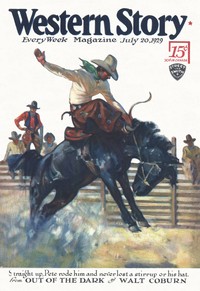
One jump ahead — A Reader’s Guide
(0 User reviews)
393
Project Gutenberg
2025
Not confirmed
Short stories; Western stories; Detective and mystery stories; Sheriffs -- Fiction; McKay, Shorty (Fictitious character) -- Fiction
Readers of public-domain and historical texts
Project Gutenberg digital edition
en
Edition facts
Words
8,447
Reading time
37 min
Text sections
1
This digital edition of One jump ahead — A Reader’s Guide is described by source-level measurements including 8,447 words, 37 min estimated reading time, and 1 detected text section.
The text analysis averages about 16.8 words per sentence, while the detected sections provide another way to judge how the source is divided.
Project Gutenberg metadata also associates the work with “Short stories,” connecting these edition facts with the source record’s subject description.
Source:
Project Gutenberg record #76082
Ray Humphreys' 1929 western mystery follows Sheriff Joe Cook and Deputy Shorty McKay as they investigate a buried box theft, with a parolee's wooden leg and a wallet clipping exposing hidden loot and political stakes.
Read the complete public-domain text at its original source.
Read on Project GutenbergRay Humphreys' One Jump Ahead opens with a precise, unhurried scene: Manuel Perez, a parolee with a wooden leg, waits outside the sheriff's office at dawn. The dialogue—marked by dialect and deliberate pauses—immediately establishes a community where past crimes are known and grudges are set aside for practical help. Sheriff Cook's sympathy for Perez's disability, despite his rustling conviction, sets a moral tone that runs through the story.
The narrative moves between two key locations: the sheriff's office, where official business and political pressure unfold, and the open terrain around Monte Vista, where clues and confrontations occur. This spatial contrast—indoor deliberation versus outdoor action—structures the plot and mirrors the tension between law and lawlessness.
Dialect and Voice as Characterization
Humphreys renders speech with heavy dialect, marking each character's background and status. Sheriff Cook uses contractions and dropped consonants: “Waal,” “thar,” “kin.” Perez's accent is thicker: “de beeg house,” “de dinero.” The commissioners speak in a mournful, formal register: “We are naturally anxious to know ef yuh got any clews.” These vocal patterns are not decorative; they signal social hierarchy and regional identity. Cook's sympathy for Perez is partly voiced through shared vernacular—he addresses him as “Perez” without condescension. The dialect also creates rhythm: the sheriff's hesitant “I—I guess” contrasts with Shorty's blunt “Looky here.”
The Wooden Leg and the Wallet: Recurring Objects
Two objects recur with narrative weight. Perez's wooden leg is mentioned three times in the opening pages: he “hobbled forward,” “hobbled around on a 'peg,'” and the sheriff's pity is tied directly to this disability. The leg is a visual marker of vulnerability and past punishment. Later, the old wallet—found by the sheriff—becomes the story's hinge. It contains a clipping that the sheriff believes proves the box thieves were the Alamosa bandits. The wallet is passed from hand to hand, read aloud, and triggers the sheriff's resignation. Both objects are small, tangible, and freighted with consequence.
Movement Between Inside and Outside
The story's scenes alternate between the sheriff's office and the outdoors. The office is a space of talk, telephones, and political pressure—commissioners arrive, the sheriff reaches for a pad to resign. Outside, action happens: Perez arrives from the train, Shorty and Perez appear in the doorway with the recovered money. The climax—Shorty's revelation of the cash—occurs at the threshold, with the trio entering “suddenly.” This movement between interior and exterior mirrors the plot's shift from investigation to resolution. The box itself was buried “under the end o' the Third Street bridge,” a liminal space between town and wild.
The Sheriff's Pride and the Threat of Resignation
Sheriff Cook's internal conflict is dramatized through small physical gestures. He “took his pride in his hands—what he had left of it” and “tried to smile and failed.” His offer to resign is made “meekly,” and he reaches for the pad with a “trembling hand.” The commissioners' silence after reading the clipping is described as his “official death knell.” Humphreys builds tension not through chase scenes but through the sheriff's slow realization that his reputation is lost. The rescue—Shorty's bundle of money—arrives just as Cook is about to write. The scene hinges on timing and the sheriff's emotional arc from defeat to relief.
Readers will find that Humphreys packs a full mystery into fewer than 9,000 words, relying on dialogue and object clues rather than extended description. The story rewards attention to dialect patterns and the way characters reveal themselves through speech. The ending, though resolved, leaves questions about Perez's full story and the fate of the Alamosa bandits—details the excerpts do not settle. Approach the text as a tight, character-driven puzzle set in a specific western landscape.
Reading this quiet mystery, I remembered how a buried box can feel like a pocket of the past. My grandfather once hid a savings bond in an old boot, and finding it years later felt exactly like that. There’s something gentle about uncovering what was deliberately tucked away. The best short stories of 1915, and the yearbook of the American short story — Reading Notes gave me that same warmth, that small thrill of a forgotten detail coming home.
There are no reviews for this eBook.
There are no comments for this eBook.
Reader reflection
Your personal reading reflection
Build a private reading journal entry for this title.
Your progress
0
/
10
2
Was reading this book enjoyable?
3
How likely are you to recommend this book?
4
How easy was the book to follow?
5
Could you follow the author’s main argument?
6
Did anything about the book feel genuinely new?
7
Would you start a conversation about this book?
8
Is this a title worth rereading?
9
Which lesson or insight stayed with you?
10