1

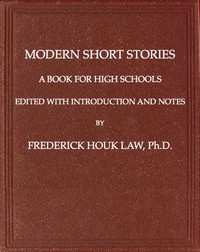
Modern Short Stories: A Book for High Schools — Reading Companion
(0 User reviews)
173
Project Gutenberg
2020
Not confirmed
Fiction; Short stories
Readers of public-domain and historical texts
Project Gutenberg digital edition
en
Edition facts
Words
115,931
Reading time
505 min
Text sections
30
The source record for Modern Short Stories: A Book for High Schools — Reading Companion measures this digital text at 115,931 words, 8 hr 25 min estimated reading time, and 30 detected text sections.
The text analysis averages about 16.4 words per sentence, while the detected sections provide another way to judge how the source is divided.
Project Gutenberg metadata also associates the work with “Fiction,” connecting these edition facts with the source record’s subject description.
Source:
Project Gutenberg record #62942
This 1918 anthology, edited by Frederick Houk Law for high school use, collects 30 stories by authors like Kipling, London, and O. Henry. The excerpts reveal a tension between the editor's pedagogical aims and the actual content, which includes a visceral, biological war narrative that defies easy categorization as 'Science Fiction & Utopias.'
Read the complete public-domain text at its original source.
Read on Project GutenbergFrederick Houk Law's 1918 anthology Modern Short Stories: A Book for High Schools presents thirty stories by authors including Rudyard Kipling, Jack London, and O. Henry, but the catalog metadata labels it 'Science Fiction & Utopias'—a classification that sits oddly with the excerpts. The preface argues that high school students need 'action, quickness, life, climax, something new and modern,' yet the longest excerpt depicts a microscopic war of 'dog-faced invaders' against 'white monsters' in a labyrinth of tunnels, with reproduction by fission and a 'geometrical progression' of attackers. This is not utopian fiction; it is a grim, biological struggle.
Pedagogical Framing vs. Actual Content
Law's preface positions the collection as a remedy for students bored by 'long expositions, descriptions, leisurely treatment, and material drawn from the past.' He promises stories of 'present-day life' and 'present-day thought.' Yet the excerpt that survives in the Project Gutenberg text—likely from Morgan Robertson's 'The Battle of the Monsters' or a similar work—depicts a surreal, violent ecosystem where 'the dog-faced invaders sought this death' and 'the number of suicides ... largely exceeding those killed by the white warriors.' This is not a slice of contemporary life but a speculative, almost clinical account of a war between alien or microscopic creatures. The disconnect between Law's stated goals and the story's content suggests that the anthology's range may be broader than its preface implies.
A Biological War Machine
The excerpt's central conflict is a relentless, mechanistic battle. The invaders reproduce by breaking in two: 'a black fighter ... was caught by a white monster ... then the two parts escaped ... the protuberance becoming the head of the rear portion, which immediately joined the fight.' This is not a moral struggle but a biological imperative, described with detached precision: 'where one died two took his place.' The setting is a series of 'caves,' 'tunnels,' and 'sponge-like' passages, with 'cross-currents' and 'rhythmical thunder' suggesting a living body or a vast machine. The language is clinical—'mechanical maw,' 'living lamps,' 'noncombatants'—and the violence is graphic: 'crushed, mangled, and cast out.' The story offers no human characters, no dialogue, and no clear allegory, making it a stark outlier in a collection aimed at high school readers.
The Anthology's Implied Audience
Law's preface explicitly addresses teachers, arguing that 'every boy or girl is certain to read short stories' and that schools should 'guide taste and appreciation.' He criticizes earlier collections that 'draw much of their material from the past' with 'authors and content alike dead.' Yet the excerpt's unrelenting, almost scientific horror—'the horrid carnival continued with never-slacking fury'—seems ill-suited to a pedagogical context. The story's complexity and lack of clear moral or thematic resolution would challenge even adult readers. This raises questions about how Law selected stories and what criteria he used to define 'modern.' The anthology may have been more experimental than its classroom purpose suggests, or the excerpt may represent an extreme example within a otherwise conventional set.
Readers approaching Modern Short Stories should set aside the catalog's 'Science Fiction & Utopias' label and instead consider how the anthology balances pedagogical intent with literary variety. The excerpt's biological war story is a reminder that early twentieth-century short fiction could be as strange and visceral as anything published today. Pay attention to how each story in the collection handles action, description, and resolution—and whether Law's preface accurately describes the contents.
That rainy afternoon, Modern Short Stories sat heavy on my lap, its war tale somehow more visceral than the editor’s tidy introductions. I kept thinking about the skipper’s quiet certainty, that stubborn human instinct beneath chaos. Later, almost by accident, I found The skipper knows best — Story, Setting & Ideas, and the same feeling returned—weather, judgment, and the unspoken pact between people who know the sea.
There are no reviews for this eBook.
There are no comments for this eBook.
Reader reflection
What did you think of this book?
Answer a few questions and save a private reflection on this device.
Your progress
0
/
10
2
Was reading this book enjoyable?
3
Would you recommend this book to another reader?
4
How demanding did the text feel?
5
How strong was your personal connection to the text?
6
Did you gain anything practical from the text?
7
Was the book easy to understand?
8
Could you see yourself revisiting this book?
9
What is the main idea you are taking away?
10