1

American short stories — A Closer Reading
(0 User reviews)
239
Project Gutenberg
2024
Not confirmed
Short stories, American; American fiction -- 19th century
Readers of public-domain and historical texts
Project Gutenberg digital edition
en
Edition facts
Words
105,819
Reading time
461 min
Text sections
42
For American short stories — A Closer Reading, the stored edition analysis reports 105,819 words, 7 hr 41 min estimated reading time, and 42 detected text sections.
The text analysis averages about 21.1 words per sentence, while the detected sections provide another way to judge how the source is divided.
Project Gutenberg metadata also associates the work with “Short stories, American,” connecting these edition facts with the source record’s subject description.
Source:
Project Gutenberg record #73141
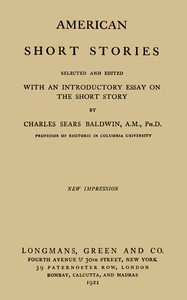
Charles Sears Baldwin's 1904 anthology traces the evolution of the American short story from inchoate tales to a distinct form, using works by Irving, Poe, and others. The editor's critical preface and headnotes emphasize formal development over thematic breadth, offering a historical lens on 19th-century American fiction.
Read the complete public-domain text at its original source.
Read on Project GutenbergCharles Sears Baldwin's 1904 anthology American Short Stories is not a simple gathering of favorites but a deliberate attempt to chart a formal evolution. In his preface, Baldwin states that the collection seeks to exhibit a development—from what he calls 'inchoate tales' into the 'distinct and self-consistent form' of the short story. He explicitly declines to select the 'best' stories, leaving that to time, and instead chooses typical instances to illustrate a literary-historical progression. The volume opens with an epigraph from Edgar Allan Poe, whose theory of the 'single effect' serves as a benchmark for the form Baldwin traces.
A Critical Framework, Not a Reader's Digest
Baldwin's editorial apparatus is unusually prominent. The introductory essay and headnotes for each author are not mere biographical sketches but critical arguments. For instance, his assessment of Nathaniel Parker Willis is blunt: Willis 'rarely has any clear solution and he never culminates.' Baldwin attributes this to a lack of 'native sense' of form, a deficiency he sees as fatal to the short story. This evaluative stance pervades the volume, making it as much a treatise on craft as an anthology. Readers should expect to encounter Baldwin's judgments directly, not just a curated selection of texts.
Poe as the Benchmark
The excerpt from Poe's 'The Fall of the House of Usher' included in the anthology exemplifies the 'single effect' Baldwin prizes. The passage builds tension through precise sensory details—'the rending of her coffin,' 'the grating of the iron hinges'—and culminates in a supernatural climax. Baldwin's preface quotes Poe's own definition of the short story as a composition where 'no word written' deviates from the 'pre-established design.' This theoretical alignment suggests that Poe's work serves as the standard against which other stories in the collection are measured, though the excerpts alone do not confirm how consistently other authors meet that standard.
The Limits of the Anthology's Scope
Baldwin acknowledges that the 'dramatic concentration' common in magazine writing by 1904 was 'extremely rare before 1835' and 'not common before 1870.' His selection thus emphasizes early practitioners like Irving and Poe, with later authors included to show the form's maturation. However, the catalog subjects list 'American fiction -- 19th century' and 'Science Fiction & Utopias,' yet the excerpts provided contain no science fiction or utopian content. The anthology's actual focus, based on the excerpts, is on literary form rather than genre. Readers should be aware that the catalog's genre tags may not align with the volume's contents, which are grounded in realism, Gothic romance, and local color.
Baldwin's American Short Stories rewards readers interested in the history of literary form more than those seeking a broad survey of 19th-century American fiction. The editor's critical voice is ever-present, shaping the reading experience. To engage fully, pay attention to the headnotes and the introductory essay, as they provide the lens through which Baldwin wants the stories to be seen. The anthology is as much about the development of a genre as it is about the stories themselves.
Baldwin’s careful tracing of how stories found their shape reminded me of a quieter pleasure—the way a particular landscape can hold a tale’s soul. His formal lens was precise, but I kept thinking of Hawthorne’s gentle, enduring figures. There’s something about that old, unhurried sense of place that lingers, like a half-remembered walk. The Great Stone Face, and Other Tales of the White Mountains — Key Ideas to Explore feels like a natural companion to that mood.
There are no reviews for this eBook.
There are no comments for this eBook.
Reader reflection
Your personal reading reflection
Build a private reading journal entry for this title.
Your progress
0
/
10
2
Did this book hold your interest?
3
Is this a title you would suggest to others?
4
How demanding did the text feel?
5
Did any part of the book feel personally relevant?
6
How valuable was this book for your own interests?
7
Would you read this book again?
8
Did anything about the book feel genuinely new?
9
In one sentence, what did you learn?
10